

18th international
Starnberg Management Days
A brief review
June 4th and 5th, 2025
New beginnings in a time of change
– act in a considered and superior manner –
-
How does one lead thoughtfully and decisively in today’s complex international landscape?
-
How does Germany’s largest company assert itself amid the currently shifting global competitive environment?
-
How do you go about developing a new ecosystem in today’s world?
-
Why is it precisely in these turbulent times that pursuing a growth strategy pays off?
-
How does the topic of sustainability hold its ground?
-
Is the vertical market approach being underestimated?
-
... and a confident perspective on current events.

The most important statements of the event at a glance...
Werner Seidenschwarz
The current international landscape is marked by a palpable “vibe shift”: disinformation, the distortion of truth, and growing political and economic fragmentation are increasingly challenging entrepreneurs and business leaders. In B2B companies in particular, speed and simplicity are gaining importance—yet not in a hectic or reactive way, but through deliberate action, operational excellence, and strategic composure. Future-ready organizations are moving away from overgrown central structures and instead rely on strong, autonomous local units, flatter hierarchies, and genuine leadership close to the customer.
Thomas Schmall
The transformation toward e-mobility will not be decided in the luxury segment, but in the volume segment, where scale and industrial excellence are decisive. Technological sovereignty is achieved through consistent systems thinking and the development of core in-house capabilities, particularly in powertrain technologies and batteries. With its own cell production, cross-brand platforms, and global scaling, Volkswagen is laying the foundation for competitiveness, cost efficiency, and long-term success in the international market.
Gunther Friedl
The Dieter Schwarz Group consistently leverages its economic strength to invest in future-oriented fields - above all, education. With the Heilbronn Campus, a unique education and research ecosystem is emerging that connects leading international universities, artificial intelligence, and new, practice-oriented learning formats. Courage to pursue new paths, long-term thinking, and openness to unconventional concepts are essential to sustainably fostering innovation and societal progress.
Theo Waigel
In times of geopolitical tension, economic uncertainty, and high public debt, historical perspective, moderation, and personal integrity are essential. Responsibility begins with the individual—not with reflexive calls for restrictions on others. Orientation arises from values, self-discipline, and a willingness to continuously reflect on one’s own actions. Stability and future viability are rooted in the ability to create order in one’s own thinking and behavior—especially when external conditions are unclear.
Jens Hardenacke
Change is not a crisis response, but a prerequisite for further development - especially when a company is already successful. Growth is driven by decentralized responsibility, clear regional P&L ownership, and the consistent dismantling of paralyzing structures. Transparency, competition, and radical focus - including the deliberate discontinuation of internal projects - enable performance, organizational satisfaction, and sustainable, profitable growth.
Ramona Lob
While sustainability, diversity, and ESG have lost some public attention, they remain strategically indispensable. The example of KeepIn demonstrates that entrepreneurial commitment, courage, and perseverance are required to build sustainable business models - even in challenging market environments. The success of reusable systems depends not only on ecological impact, but above all on convenience: only if reuse is simple, understandable, and convenient for end users can it succeed at scale.
Andrea Rungg
Media dynamics increasingly follow the principle that “only bad news are good news,” giving greater weight to confrontation and negative headlines. TikTok counters this with a strong culture of execution and learning, supported by clear values, short steering cycles, and a consistent OKR logic. The platform’s success is based on an interest-driven algorithm, data-based decision-making, and clearly separated governance, compliance, and data structures within an internationally structured technology group.
Andreas Penkert
Go-to-market approaches in the tire industry are among the most complex industrial sales models and require rigorous vertical-industry strategies. Increasing product variety, larger and heavier products, and rising logistics requirements are placing significant pressure on inventory management and performance. Customer proximity, close integration of capable wholesalers, and data-driven steering are becoming decisive success factors in a highly consolidated market.

There are currently too many countries that - from the perspective of a civilized world - act like alienated drivers, displaying a new level of ruthlessness in their day-to-day conduct,” said Werner Seidenschwarz at the opening of the 18th International Starnberg Management Days.
This reflects a vibe shift that set in during the transition from 2024 to 2025. “In a very short period of time, the way the world feels has changed. Information is increasingly being flooded, truths are distorted, and lies are becoming part of everyday life.” For entrepreneurs and business leaders, it is therefore a critical responsibility to ensure that these behavioral patterns do not permeate the day-to-day operations of well-functioning companies.
Change and transformation have been widely discussed for some time, given the profound shifts in society and markets. What is becoming increasingly important on a daily basis in B2B companies, however, is speed and simplicity. Being simple and fast - but not blind, not hectic, not reactive. Not cutting the grass quickly and superficially. Instead, acting deliberately and with a deep respect for operational leadership - strategically and with confidence - “lowering” organizations structurally and pursuing revolutionary approaches to organization and collaboration, in order to focus on what truly matters: work close to the customer. Companies that have embraced this mindset have already built a competitive edge. Those that have not are now under pressure.
At the local level, companies are currently experiencing a fragmentation of established market and political structures. This makes it essential to strengthen regional management and its relative autonomy. At the same time, organizations must remain alert in all countries and regions - living “Day One” every day and continuously reflecting on what truly differentiates the company locally.
What we are seeing is a clear shift away from centralized structures and powerful, overgrown headquarters toward highly autonomous local units capable of responding effectively to regional conditions.
Concepts such as Dynamic Shared Ownership are beginning to take hold. They enable “multiple chefs to work on multiple dishes at the same time.” Hierarchical layers are being radically reduced, unnecessary coordination functions eliminated, and work is moving closer to the customer. Leaders and employees alike are developing faster and growing into their roles.
Operational managers are becoming on-site leaders - people who lead, coach, and develop their teams.
As a result, organizations are regaining time for strategic and tactical leadership, employee development, and active engagement with customers 😊.

In the view of the organizer, Thomas Schmall is currently one of the most important figures within the Volkswagen Group.
He is responsible for the very core of electric powertrains. “If he succeeds with his initiatives, Volkswagen will return to a path of success. The technological transformation of Germany’s largest company stands or falls with him,” said Werner Seidenschwarz.
“E-mobility works differently in the luxury segment than in the volume segment.” With its twelve group brands, Volkswagen is therefore focusing its battery strategy primarily on the relevant 80 percent of the volume segment. Concerns about insufficient charging infrastructure in Germany are also increasingly giving way to a more positive outlook, Schmall noted: “Germany now has around 172.000 charging points, compared with approximately 150.000 fuel stations.”
In China, more than 50 percent of revenues are expected to come from electric vehicles by 2030 - the so-called xEV sales.
For this success to be replicated in other markets, customers must be convinced that they are receiving a technologically superior product.
For this reason, Volkswagen is striving to keep the powertrain module - electric drive, inverter, and battery - in-house. This system-level approach eliminates the need for complex coordination of individual modules and off-the-shelf components, enables scale effects, and allows technology platforms to be deployed across brands.
With PowerCo, Volkswagen is therefore establishing its first group-owned battery cell production, as battery cells account for roughly 40 percent of total vehicle costs. Around 1,000 employees are already working on joint development activities to build deep battery-cell expertise. A make-and-buy strategy - starting in Europe with sites in Germany and Spain, followed by North America - will evolve from a cell-to-pack approach toward a later cell-to-car model. In doing so, Volkswagen is building up a capacity of around 100 GWh, with further expansion stages to follow.
Thomas Schmall felt so at ease among the top managers gathered at Lake Starnberg that he even offered to host the event in 2026 at Volkswagen’s new battery plant, welcoming participants from business and industry.

Gunther Friedl, a representative of the Dieter Schwarz Group and Managing Director of the foundation bearing the same name, spoke on behalf of what has meanwhile become Germany’s second-largest corporate group, employing around 188.000 people - including Lidl. The sheer scale of the Dieter Schwarz Group is still largely underestimated by many.
What distinguishes this group and its founder is a clear guiding principle: “Dieter Schwarz invests his profits in everything that represents the future - and above all, in education.” According to Forbes, with an estimated net worth of USD 49,8 billion, he is currently the wealthiest German, ahead of logistics entrepreneur Klaus-Michael Kühne, industrialist Reinhold Würth, and BMW heirs Susanne Klatten and Stefan Quandt.
The success story of the Dieter Schwarz Campus in Heilbronn, together with the IPAI Innovation Park Artificial Intelligence, is emerging as a key German contribution to Europe’s development in artificial intelligence. The entire education and research ecosystem in Heilbronn is breaking new ground - ranging from family education initiatives to the establishment of leading international universities such as the Technical University of Munich, ETH Zurich, Stanford University, and Nanyang Technological University Singapore, as well as the free, non-profit IT school 42Heilbronn.
Admission to 42Heilbronn does not require any formal degree - only an open selection process. Likewise, there is no formal graduation. Instead, its self-organized, peer-based, gamified, and project-driven learning model enjoys strong popularity among students and is highly valued by companies recruiting its graduates. Participation numbers are developing very positively.
“Something fundamentally new has been dared here...,” Werner Seidenschwarz remarked, adding, “hopefully the courage to pursue this ecosystem will be maintained in the future as well.”
It is no coincidence that Gunther Friedl joined Lidl. He is widely regarded as a key driving force from the Technical University of Munich, which is also home to Europe’s largest start-up center, UnternehmerTUM - where around 100 start-ups are founded each year, including companies such as Celonis and FlixBus.
For Werner Seidenschwarz, it was therefore a particular source of pride to have previously served as a member of the advisory board there.

In contrast to the usual format of the International Starnberg Management Days, Werner Seidenschwarz chose this year - given the tense global political and economic environment—to forgo an evening program featuring figures from sports or music.
Instead, entrepreneurial dialogue and substantive exchange were deliberately placed at the center of the evening as well. That the event’s sole evening guest, Theo Waigel, also brought a strong element of wit and entertainment was a gift to both participants and organizers.
In a one-hour conversation with Werner Seidenschwarz, the grand seigneur of German politics reflected on current crisis hotspots and international developments. With ease and depth, the two discussed issues such as public debt, special funds, and the role of investment programs, drawing on historical success patterns to explore how to deal with extraordinary circumstances - ranging from unusually behaving presidents to regional tensions and shifting political paradigms. “Mr. Euro” Theo Waigel and the Starnberg-based professor, networker, and entrepreneur fully drew on their combined experience.
The evening concluded with two of Theo Waigel’s personal guiding principles: “I will not lose my character. I will remain true to myself.” It therefore felt particularly fitting when he shared with Werner Seidenschwarz that he had been a close friend of Helmut Schmidt—an image that resonated with the presence of two strong political figures, each with a distinct profile. Another of his reflections captured the spirit of the evening: “It is about recognizing the order of things and bringing oneself into order.”
This message resonated deeply with the event as a whole. Each of the exceptional personalities—both on stage and among the actively engaged audience—approached the discussions with the same underlying question: What can I do better, and how can I contribute to the broader development? Beginning with oneself, rather than pointing at others or calling for tighter belts elsewhere, consistently earns respect—and makes it easier to inspire others to continue developing themselves.
“Learn in order to live. Live in order to learn.” With these words, Werner Seidenschwarz concluded an event that, in challenging times, conveyed a great deal of motivation and determination for renewal amid transformation—always with the awareness that the outcome may be “fifty-fifty”: that things could turn out very well, or that cross-border developments may unfold in ways one would strongly hope to avoid.

Jens Hardenacke opened the event with a strong and pointed statement: “Change is not for underperformers, but for everyone who wants to continue developing - especially when things are going well.”
Participants were inspired and energized by the CEO of Kardex and Leading Sales member. He succeeded in drawing the audience into a genuine growth mindset. Werner Seidenschwarz knows Jens Hardenacke from joint project work and recalled a memorable experience: “I saw him in Paris, where he captivated 220 executives for two full hours—from the first to the very last second. No one leaned back, no one disengaged. Everyone was carried along by his energy.” Not many leaders can do that.
A central element of his growth story is the deliberate move away from paralyzing organizational structures. Today, the regions are at the center. Functions exist to support the regions, and full P&L responsibility lies with them.
The shift from a cost-driven mindset to a growth-oriented one is a tough journey. It requires resisting the reflex to turn first to cost-cutting and instead identifying growth opportunities - and then pursuing them decisively.
Stronger performance thinking requires transparency as a normal state. There is nothing to hide. Jens Hardenacke experienced this early in his career at Gildemeister, where “transparency and competition” were part of everyday business. No strong sales professional is afraid of that.
As part of this focus, 75 percent of internal projects were discontinued. It would be naive to assume that these topics simply disappear - but clarity and focus emerge. “Whenever we start something new, an existing topic or project is stopped. We choose what creates the greatest value for the organization.”
Overall, satisfaction within the organization has increased, and initiatives can now be brought to completion more effectively. Growth also enables Kardex to invest in start-ups. Technologies needed to complete the portfolio further strengthen the company’s growth foundation - for example, multi-shuttle systems.
While EBIT margins may come under pressure during phases of growth, Jens Hardenacke is familiar with this dynamic from his previous successes. Decentralized, empowered, and lean structures, however, are capable of growing profitably.
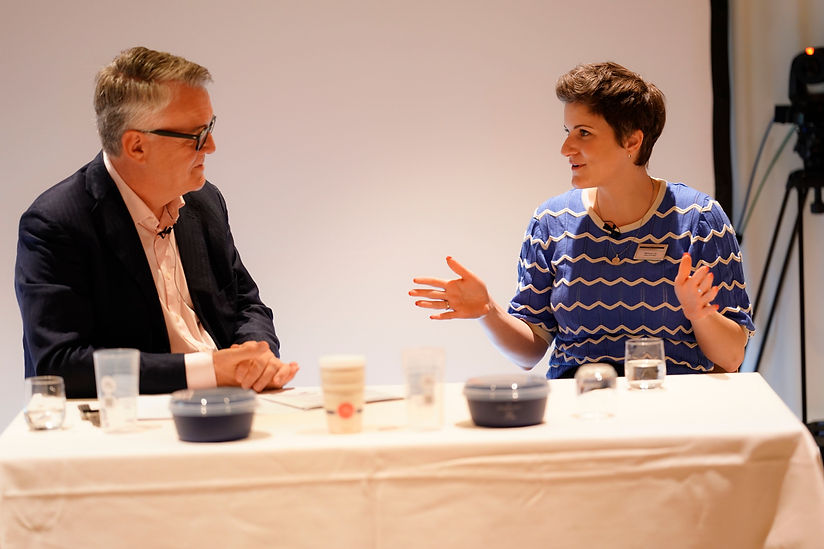
Why many companies are currently scaling back or quietly discontinuing their diversity and ESG programs is a decision each organization must make for itself. Anyone assuming that this is limited to traditional companies would be mistaken. In fact, a growing number of so-called “modern” brands - from technology and consulting to the pharmaceutical industry - are also taking this path.
The Seidenschwarz group of companies, by contrast, will continue to actively support these topics. They remain fully committed to strengthening and developing younger generations in an open and inclusive manner - this explicitly includes the promotion of young female leaders.
The Jokey-driven start-up KeepIn did not emerge by coincidence, nor is it led by a young female executive by chance. In 2023, Jens Stadter delivered an impressive speech on the unique strengths of the packaging manufacturer Jokey, with a particular focus on sustainability.
The example of KeepIn clearly illustrates this commitment - even though the path of building a start-up is demanding and often arduous. Ramona Lob herself represents a courageous young leader who has taken on exactly such a challenge. Confronted with extensive build-up work and cold acquisition, this role requires going the extra mile - especially in today’s tense market environments.
Climate protection may no longer command the same level of attention as in previous years given current global developments, but it is by no means disappearing. France is ahead of Germany when it comes to reusable systems; at McDonald’s in France, reusable packaging is now standard.
Some of the biggest obstacles to broad implementation include a lack of consumer information (“Where can I get reusable products? Where can I return them?”), as well as challenges related to return systems and logistics.
“Single-use burdens, reuse relieves.” However, reuse must be convenient for the end customer. This is already visible in amusement parks, at events, and in cities such as Copenhagen, where KeepIn operates. The key question is whether this level of convenience can also be achieved in corporate environments.

Andrea Rungg did not limit her contribution to the current phenomenon of TikTok alone. Drawing on her extensive experience in communications and media relations with leading German daily newspapers, top-tier magazines, and press agencies, she also addressed broader questions extending well beyond the platform itself.
Confrontation and negative headlines are currently gaining ground. The principle that “only bad news are good news” continues to apply - and it appears to be more deeply entrenched in media practice today than ever before. As Rungg noted, it remains firmly embedded in the industry.
The central focus of her contribution, however, was TikTok - its culture and its self-image as a creative and authentic community. In a short period of time, the company has grown from 350 employees to more than 6.000 across Europe, particularly during the COVID period. Its way of working is characterized by a strong focus on execution and has recently evolved from two-month cycles to three-month cycles, including OKR-based measurement.
Within the company, six core values guide behavior and decision-making:
-
Always Day 1 – Acting with a start-up mindset: curious, eager to learn, and free from complacency.
-
Be Candid and Clear – Communicating openly, honestly, and clearly, especially on difficult topics.
-
Be Courageous – Making bold decisions, taking risks, and assuming responsibility.
-
Stay Humble – Remaining grounded, not taking success for granted, and continuously learning.
-
Diversity & Inclusion – Valuing different perspectives, actively fostering diversity, and collaborating with respect.
-
Grow Together – Growing together as a team, organization, and individuals. Sharing both successes and setbacks.
TikTok’s success is based on a fully interest-driven user algorithm, which learns very quickly—for example, how long users watch a video and how they interact with it. In Europe, data flows are monitored by a British company, at a cost of around EUR 12 billion for TikTok. “We are comfortable being measured by facts,” Rungg emphasized. “Being judged by gut feeling, however, is much more difficult.”
TikTok is also increasingly becoming a competitor to Amazon. E-commerce represents a large and strategically important market for the company, characterized by extensive trial and error. The TikTok Shop has made a strong start, and 67 percent of users report making purchase decisions based on products they have seen on TikTok.
In her day-to-day work, Andrea Rungg places strong emphasis on continuous monitoring—assessing what stakeholders are saying about TikTok, ranging from academia to media and politics—as well as close collaboration with her team to safeguard the platform. This includes identifying harmful trends or user behavior and developing solutions to questions such as whether certain content is legally compliant and ethically appropriate.
Finally, it is important to note that TikTok no longer has a purely Chinese ownership structure. Instead, it is part of an internationally structured, privately held technology group with significant international—including Western—investors, as well as clearly separated governance, compliance, and data structures.

Drawing on many years of experience, Andreas Penkert - widely regarded as the expert in the European tire industry and a former employee of the Starnberg-based firm Seidenschwarz & Comp. - shared deep industry insights with the audience.
Go-to-market approaches for tire manufacturers are among the most complex across all industries. Penkert provided comprehensive perspectives on this complexity and demonstrated how critical vertical-industry strategies are for effective market and sales approaches.
In recent years, the industry has undergone a fundamental shift—from a model where “20 percent of products generate 80 percent of revenue” to one in which “80 percent of products account for 80 percent of revenue.” Today, manufacturers can only operate close to the customer by integrating wholesalers more deeply into their logistics networks. Beyond their traditional trading role, wholesalers are increasingly taking on broader logistics responsibilities, including operating their own warehouses. This development is turning the remaining players in a highly consolidated wholesale market into growth drivers.
Well-organized wholesalers are beginning to act like manufacturers when it comes to sales and commercial activities.
The revenue split in the industry between original equipment (OE) and aftermarket business is approximately 30:70. A strong presence in original equipment subsequently creates a pull effect for the aftermarket business.
Tires continue to become larger and heavier, mirroring the trend toward larger, heavier, and more powerful vehicles. Rim sizes are increasing as braking systems grow larger, which in turn requires larger warehouses and significantly raises logistics requirements.
In Germany, the replacement market comprises around 50 million tires annually, plus an additional 15 million more price-driven imported tires from China and India. Over the past four years, the product portfolios of the top six manufacturers have expanded by 21 percent overall—and by more than 47 percent in the segment above 18 inches. At the same time, these developments have led to a reduction of warehouse space by around 25 percent over the past five years, significantly increasing pressure on logistics performance.
Finally, an increasing number of chips are being integrated into tires—no longer only in original equipment for premium vehicles. This enables more than just adaptive responses to cold or warm road conditions; enhanced data collection and analysis are also helping manufacturers improve demand planning.

So that the participants could take home three good ideas from the event again this year, which they can also implement directly!
“It was an unusually lively exchange of ideas with the participants of the International Starnberg Management Days. The atmosphere and setting were outstanding.”
Theo Waigel, grand seigneur of German politics, former Federal Minister of Finance, Mr. Euro
“A strong program. Outstanding!”
Joachim Silber, Head of Global Marketing, TRUMPF, Ditzingen
“Impressive entrepreneurs demonstrated how responsibility and innovation can be used to successfully address the challenges of our time. For me, the Starnberg Management Days are always a great source of inspiration.”
Thomas Vogl, Chairman of the Management Board, VR Bank Starnberg-Zugspitze